
Lyon County VINELink Changed
Nevada changed notification systems in 2025. The Attorney General described S.A.V.E. as offender-based, which lets one registration follow later covered incidents involving that offender. The former VINE model was incident-based. Most existing registrations migrated, but registrations made through the old VINE app required new registration. Current Lyon instructions point to Nevada S.A.V.E. and its phone service, not to VINELink.
The Lyon County Sheriff’s current inmate page expressly sends users to S.A.V.E. to learn whether a person remains in custody and to register for release notice. The statewide framework also receives data involving sheriffs, NDOC, the Department of Public Safety, and the Parole Board. Coverage does not make the portal a certified record. NDOC calls the service supplemental and says NDOC-supplied data is not an official NDOC record.
The service is offender-based, but the source event still comes from a participating custody agency. A Lyon jail event and an NDOC event are not interchangeable. Someone sentenced in Lyon County may later appear in the statewide corrections system after transfer, while a person whose case ended at the county jail may have no NDOC record at all. Matching the agency prevents a false no-result.
LCSO also publishes a phone path at 866-393-5445. That channel can help when the web portal is hard to use or unavailable. Follow its current prompts and write down the exact answer, time, and identity details used. A phone response still needs the same follow-up: if the person is no longer in Lyon custody, ask the Sheriff record or receiving agency whether the event was release, transfer, or another form of departure.
The official transition announcement is preserved in the image below.
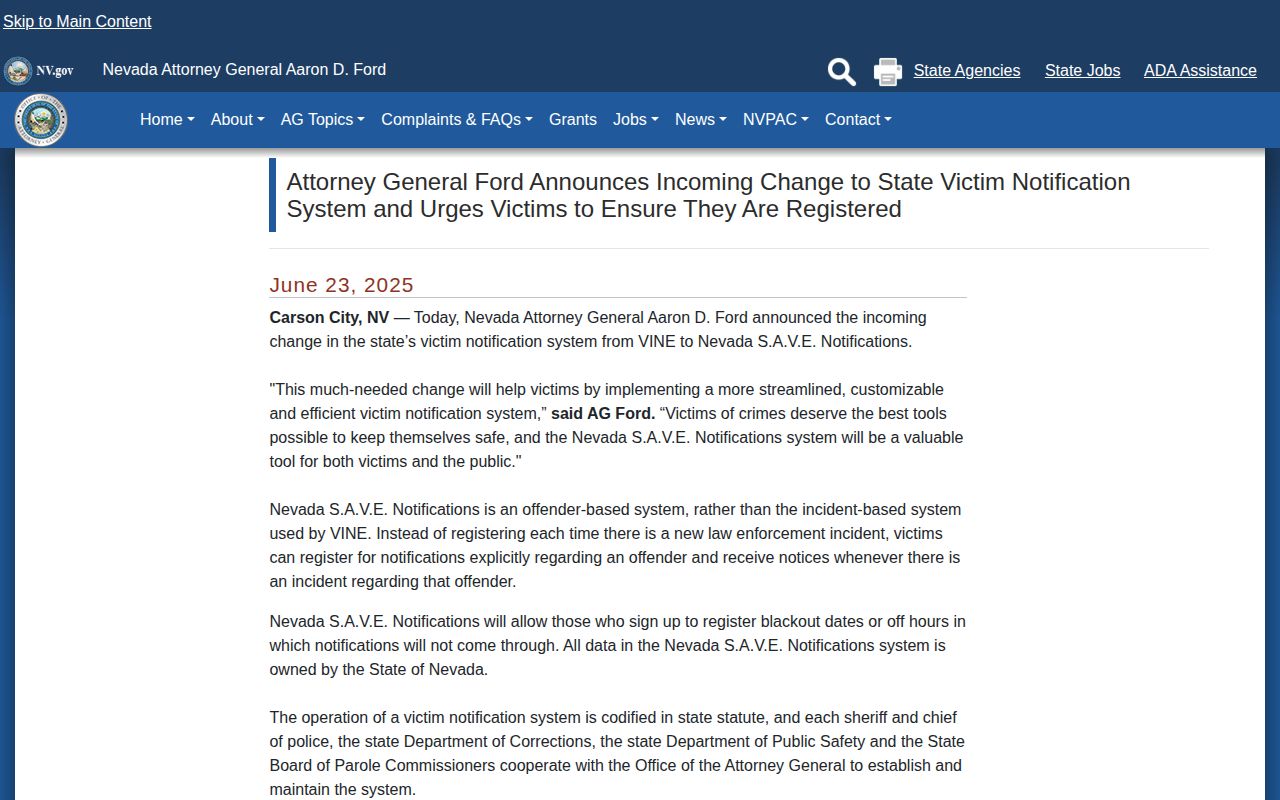
The announcement explains why a current Lyon County check should not start from a legacy VINELink page.
Search Lyon County S.A.V.E.
The current portal is interactive, and its exact fields or labels can change. Follow the live prompts instead of copying an old VINELink field list. Use enough identity detail to separate people with similar names. Then read the custody wording exactly as displayed.
- Open S.A.V.E. or call 866-393-5445, the route published by the Lyon County Sheriff.
- Follow the current search prompts for one specific offender. Compare the identifying details that the service displays.
- Open the matching record and note the stated custody or facility status without changing its wording.
- If the person is no longer in covered custody, check the Lyon release sheet or receiving agency before calling the event a community release.
- For an NDOC case, compare the result with the official NDOC offender search and release history.
County and state custody must remain separate. The Sheriff app is mainly a current Lyon jail source. NDOC covers state prisoners and can preserve release or discharge history. The Lyon County released-inmate search adds court and records-request paths when S.A.V.E. does not settle the question.
Lyon Release Alert Fields
S.A.V.E. is useful for a current answer and covered custody-change alerts. Its live result controls the precise fields. The research did not establish it as a booking-photo source or a complete release archive. Do not infer either feature from the old VINE brand.
| Item | How to read it |
|---|---|
| Offender identity | Use displayed details to avoid a same-name mismatch. |
| Custody answer | Shows whether the person remains in the covered custody at that update. |
| Facility or agency | Helps identify which office should confirm the source event. |
| Custody-change notice | May report a release, transfer, or other covered event; verify the event type. |
| Contact registration | Uses the channels and confirmation process offered by the current portal. |
A “not in Lyon custody” answer has more than one possible cause. The person could have entered the community, transferred to NDOC, moved to another county on a warrant, or entered federal or immigration custody. The Sheriff booking and release record can show the maintained reason and destination fields. A court docket can explain the order behind the departure.
Register Lyon Release Notifications
Use only the account and notification controls that S.A.V.E. offers now. The current portal should determine available channels and the confirmation flow. Contact details must stay current, and any confirmation should be retained. Critical plans should not depend on one automated message because source data and delivery can lag.
- Find and verify the specific offender in the current S.A.V.E. service.
- Choose the live registration control attached to that record.
- Select from the notification channels actually offered on screen.
- Complete the displayed verification or confirmation steps and save the confirmation.
- Confirm a received alert with LCSO, NDOC, the Parole Board, or a receiving agency as the event requires.
NDOC also accepts direct victim-notification registration through its Victim Services Unit. Parole Board victim services handles Board notices. NDOC recommends those direct official channels in addition to S.A.V.E., because S.A.V.E. is supplemental rather than a certified correctional record.
For direct NDOC registration, the research identifies NDOC Victim Services at NDOCVictimServices@doc.nv.gov and 5500 Snyder Avenue, Carson City, Nevada 89701. Board registration uses ParoleBoardVictimServices@parole.nv.gov at 1677 Old Hot Springs Road, Suite A, Carson City. Requests should include the offender’s full name and NDOC ID, the requester’s relationship or reason, and current contact information.
Lyon VINELink PIN History
An older Lyon County victims page still points to VINE and VINELink. That page is stale when compared with the Sheriff’s current S.A.V.E. directions. Historically, Nevada VINE allowed phone or email registration after a named person was found. Telephone registration asked the user to choose a four-digit PIN. Email registration did not use that phone PIN.
When a legacy automated call arrived, the recipient entered the PIN and then the pound sign to acknowledge it. Without acknowledgment, the service could leave voicemail and repeat calls for up to 48 hours. Those details explain old records and saved instructions only. They must not be transplanted into S.A.V.E. registration, and no current S.A.V.E. PIN should be assumed.
Lyon Release Check Limits
S.A.V.E. does not replace every custody system. Ordinary county-jail-only cases belong with LCSO records. State-prison status and release history belong with NDOC. The federal Bureau of Prisons locator covers BOP records, while ICE maintains its own detainee locator. A transfer out of Lyon County can therefore make the local result disappear even though the person remains in government custody.
Data lag is not just theoretical. During Nevada’s 2025 cyber incident, Lyon staff tracked bookings and releases manually while the state-hosted system stopped feeding app updates. Pair any electronic result with a direct custody check or source record when timing matters. S.A.V.E. supplies a useful alert, but the Sheriff release sheet, NDOC record, court order, or receiving-agency entry supplies the official context.
Federal coverage requires another route. The BOP locator shows federal records from 1982 onward and can display a release date or “Not in BOP Custody.” ICE’s locator can include qualifying people released from ICE custody within the prior 60 days. Neither result proves freedom from all other custody or supervision. Lyon has no verified operating federal or ICE detention facility, but a transfer from the county jail can still lead into one of those systems.
Note: A live roster shows present custody; a release record documents how and when the prior custody ended.
When S.A.V.E. and another source disagree, preserve both exact results and contact the agency that supplied the custody event. For a county booking, ask LCSO for the booking and release sheet with the date, release reason, authority, and destination fields it maintains. For a state prisoner, request the NDOC release history by offender ID. The Lyon court docket can then explain the order or sentence behind the physical move.
A current app result should be read with the same care. The Sheriff app is the official public route for inmate information, but no official 24-hour or 72-hour release archive is promised. Someone disappearing from the app may have been released, transferred, corrected in the data, or affected by an outage. S.A.V.E. can add a second status signal, while the source record resolves the reason.
Lyon Registry Alerts Differ
LCSO OffenderWatch lets a user register an address for notices concerning registered sex offenders nearby. Nevada’s official registry also supports specific-name, address-distance, and ZIP searches after its conditions are accepted. These systems serve a different purpose from S.A.V.E. OffenderWatch follows registry information around an address; S.A.V.E. follows covered custody events for a selected offender.
Neither system proves every jail release. Nevada law limits which registrants appear on the public registry, and most released people are not part of that registry at all. A registry result or absence should never be used as a substitute for the Lyon release sheet, the court disposition, or the correct state or federal custody source.
OffenderWatch questions can be sent to the Lyon Sex Offender Task Force at SOTF@lyon-county.org. That office can address Lyon registry issues, not general inmate release status. Keeping the two notification paths separate protects the meaning of each result and keeps a registry alert from being mistaken for a custody-change notice.
The public Nevada registry also warns that information changes and positive identity cannot be guaranteed without fingerprint comparison. Public coverage excludes some registrants by statutory tier and victim category. Those limits reinforce why a registry name match must not be treated as the S.A.V.E. offender match or as evidence of a particular release date. Verify the person and event separately.