
Lyon Projected and Actual Release
A projected date is an administrative calculation based on the judgment, sentence structure, confinement credit, and the law that applies to the offense. NDOC calls its key estimate a projected expiration date and says it is conditional. Its computer assumes certain maximum flat, statutory good-time, and work credits. Those credits post monthly, while meritorious credits are not estimated in advance.
An actual release date records what happened after staff resolved the sentence, holds, orders, and final processing. NDOC’s sentence-estimate memo says the system ordinarily locks an actual date about 7 to 10 days before release. Even then, the source record should control. For Lyon jail custody, the Sheriff release sheet records the physical departure and reason. A court order may authorize release earlier than jail staff complete it.
Pretrial custody works differently. A detainee who has not received a jail or prison sentence may leave after bond, own-recognizance release, dismissal, or another court order. No sentence calculation can predict a ruling that has not happened. The current app or S.A.V.E. can help check custody, but neither turns a pending court case into a fixed date.
Find Lyon Projected Release Dates
Start with the custody type. The Lyon County Detention Facility holds local detainees and some people serving local terms. NDOC holds state prisoners after commitment and transfer. Leaving the Lyon roster for NDOC is a transfer, not a community release. The Lyon County release search provides the broader path when custody type is uncertain.
- Obtain the judgment. Check the offense and sentence dates, minimum and maximum terms, concurrent or consecutive structure, and credit for presentence confinement.
- For a state prisoner, search the NDOC offender portal by ID or name. Read the displayed labels exactly and review booking, parole, and release history.
- For a county sentence, ask the Lyon jail records route for the computation and ask the correct court clerk for the judgment and later orders.
- Check Parole Board schedules and monthly actions if parole eligibility affects the expected path. A hearing date is not a release date.
- Before relying on an estimate, confirm holds, amended orders, and any receiving agency. After departure, obtain the actual release record.
The NDOC portal warns that it presents raw data rather than an official record. Blank download fields do not prove the agency has no date in its official file. NDOC Offender Management Division accepts questions about official sentence calculations, while NDOC public records can supply a formal release history or computation record.
NDOC Family Services provides general inmate guidance at 775-977-5707. Sentence Management is listed at 775-887-3298, and Offender Management Division records can be requested through omdrecords@doc.nv.gov. A precise request should identify the offender ID, the sentence or booking at issue, and the date field that needs explanation. That approach is more reliable than guessing what an abbreviated download column means.
Lyon State Sentence Credit Rules
Nevada does not have one sound “serve 85 percent” rule for all state prisoners. NDOC sentences are shaped by indeterminate terms, offense-specific limits, parole law, and the credit statute effective for the offense. A federal good-conduct shorthand should not be imported into a Nevada sentence. The person’s judgment and governing version of state law must be used.
NRS Chapter 209 contains the state-prison credit rules. NRS 209.4465 governs general statutory credits for offenses committed from July 17, 1997 through June 30, 2027, subject to limits on applying credits to minimum terms for specified crimes or circumstances. Earlier cohorts can fall under NRS 209.433, 209.443, or 209.446. NRS 209.4467 establishes a revised regime effective July 1, 2027. Additional credit, forfeiture, and restoration rules may also matter.
Start with the judgment, not with a web calculator. Apply presentence credit, the correct effective-date law, sentence aggregation, and actual credits posted by NDOC. Concurrent terms run together to the extent ordered. Consecutive terms run in sequence. The official computation is essential when a public field looks inconsistent.
Note: Nevada credit law changes by offense date and sentence facts, so a single statewide percentage can misstate the release estimate.
Why Lyon Release Estimates Change
Projected dates move when one of their inputs changes. Some changes affect the sentence itself. Others affect whether physical release can occur when the sentence calculation reaches a milestone. A detainer, meaning another agency’s request to hold or take custody, may prevent community release without changing the underlying sentence expiration.
| Factor | Possible effect | Record to check |
|---|---|---|
| Corrected jail credit | Moves the calculation after time-served credit is revised | Judgment and computation sheet |
| Amended judgment | Changes a term or concurrent/consecutive structure | Lyon court file |
| Credit earned, lost, or restored | Changes an NDOC or local estimate under applicable law | Official sentence calculation |
| Parole grant, denial, or deferment | Changes the expected community-release path | Board monthly action and NDOC record |
| Detainer or warrant | May cause transfer to another agency instead of release | Holding and receiving agencies |
| Data correction | Changes a public field without a new court event | NDOC or jail source record |
Parole is not automatic at eligibility. Board hearings are generally set about three months before the minimum eligibility date, but institution moves or eligibility updates can change timing. A grant requires ratification and may depend on an approved release plan. Monthly action reports can also place a late-month result in a later publication.
Confirm Lyon Release Dates
For a pending state-prison event, compare the NDOC public result with the judgment and an official sentence-computation record. Use Board actions when parole matters. For a pending Lyon jail event, the official jail route and Lyon court directory answer different parts of the question: the court supplies legal authority, while the Sheriff records physical release or transfer.
Nevada S.A.V.E. can add a custody-change alert for a covered person. Nevada replaced VINE and VINELink in 2025, so the current Lyon release-alert instructions use S.A.V.E. and label the old phone PIN steps as history. Automated notice is supplemental. Confirm an alert with NDOC, LCSO, or the receiving agency.
After the event, seek the actual release history. NDOC’s downloadable release table identifies an offender, booking, release date, and release description, while the Lyon Sheriff record may maintain the local release time, reason, authority, and destination. That final record distinguishes an estimate from a completed departure.
The LCSO inmate page is a current-custody and notification route, not a projected-date calculator. A disappearance from current data does not supply a release date and cannot distinguish release from transfer.
Lyon County Jail Credits
County jail credits come from a different statute and must not be calculated with NDOC rules. Under NRS 211.320, the sheriff or chief may deduct up to five days per month for obedient, orderly, and faithful conduct. Work credit may add up to ten days per month for a term of at least 270 days, seven for 180 to 269 days, five for 30 to 179 days, three for 15 to 29 days, and none for a term under 15 days. Partial months are prorated.
NRS 211.330 and 211.340 allow limited additional qualifying program or treatment credits. Credits can be forfeited after process. These are statutory inputs, not proof of what Lyon awarded in one case. No public Lyon policy was verified that states which discretionary credits are routinely awarded, sets a fixed release hour, or automatically moves a weekend date to Friday.
Request the local judgment and Lyon computation record. Check all other cases and holds. Then obtain the release sheet once processing is complete. This channel-specific method avoids using a state-prison formula for a county sentence.
A local court file can also show credit for time served, an amended judgment, a probation order, or a warrant that changes the expected path. The court supplies the legal command. Jail staff apply that command alongside local credit and custody information. Their dates may differ because judicial authorization and the physical completion of release are separate events.
Lyon NDOC Date Fields
NDOC’s downloadable Booking data contains sentence fields labeled sent_ped, sent_mpr, sent_pexd, and sent_rrd, along with sentence status, start date, and minimum and maximum terms. No current official data dictionary was found that safely expands every abbreviation. Preserve those field names unless a current public result supplies the exact human-readable label.
The official NDOC search form shown below is a successful manifest image.
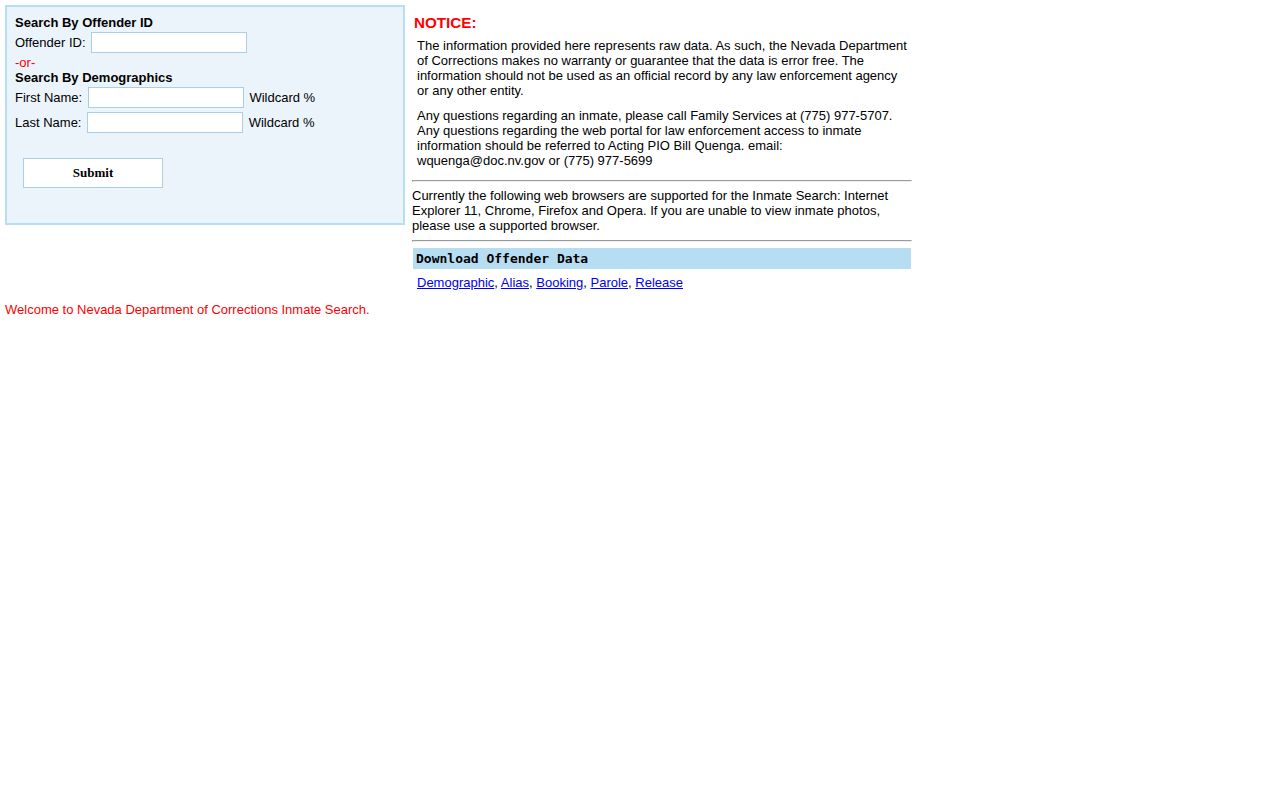
The form searches state correctional data, not an ordinary Lyon County jail-only booking, and its results should be verified through NDOC records.
NDOC’s Demographic download can preserve an inactive or discharged status such as INACTIVE-DSCHREL. The Release table carries release_date and release_desc, and the Parole table can carry a hearing date and location. A hearing field is not a grant. A release row is historical evidence, while the public search status gives a current snapshot based on the state data.
For an official copy, NDOC lists publicrecords@doc.nv.gov and 775-977-5649. Inspection hours are Monday through Friday, 8 a.m. to 5 p.m. The published schedule lists 15 cents per copied page and actual electronic-media cost, subject to Nevada public-record rules. Ask for the release history, sentence computation or date sheet, and relevant movement history by offender ID.
Lyon Release Date Records Law
Nevada’s Public Records Act supplies a source-record route when a search screen is unclear. NRS 239.0107 requires an agency response by the end of the fifth business day through production, a custodian referral, a written delay notice with an estimated date, or a written confidentiality denial. NRS 239.052 generally limits copying charges to actual cost unless another law controls.
Request an existing record, not a new prediction. For NDOC, ask for the sentence computation and release history. For Lyon County, ask for the judgment, jail computation, and booking or release sheet. If part of a record is withheld, ask for the public remainder and the legal basis for each redaction. This method preserves the difference between an estimate shown online and the agency record used to make or confirm it.
Keep the request tied to one person, one sentence, and a defined date range. That scope helps the custodian locate the existing computation without asking the agency to create a new forecast.